Ghismonda
The DecameronGhismonda is the daughter of Tancred, Lord of Salerno, and the central figure in a tragedy about desire, social rank, and the destructive consequences of a father’s attempt to govern his daughter’s life. Her love for Guiscardo, a serving-man of low birth but distinguished character, becomes a private marriage in all but public recognition. When Tancred discovers them, Ghismonda refuses both denial and supplication: she asserts the truth of her desire, then meets her lover’s murder with a death she has prepared for herself.
Identity and Circumstances
Tancred has only one child, a daughter he loves so tenderly that he delays marrying her again even after she has long passed the age when she should have had a husband. Ghismonda’s first marriage, to a son of the Duke of Capua, ends when she is widowed; she returns to her father’s household and lives there in ease and luxury. She is described as beautiful, young, spirited, and unusually learned. Her position gives her rank and comfort, but it also leaves her dependent on Tancred’s judgment about her future.
The mismatch between her circumstances and her wishes shapes the crisis that follows. Tancred does not arrange another marriage, while Ghismonda does not think it seemly to demand one of him. Surrounded at court by men of different manners and stations, she privately chooses Guiscardo, a young servant whose birth is humble but whose conduct and worth, in her estimation, surpass those of the others. Their difference in rank is not incidental: it is the point on which Tancred’s objection will turn, and the point Ghismonda later challenges.
Secret Love and Discovery
Ghismonda and Guiscardo recognize and return each other’s affection. To arrange a meeting without confiding in anyone, she places a letter inside a hollow cane and gives it to him under the pretext that it should be made into a bellows for a servant. Guiscardo understands that the gift has another purpose, finds the letter, and follows its instructions. The secret route enables him to reach her unseen; once he has learned the way, he returns repeatedly.
Their secrecy fails when Tancred enters Ghismonda’s chamber while she is away in the garden. He sits at the foot of her curtained bed, conceals himself, and falls asleep. Ghismonda later comes in, opens the hidden door for Guiscardo, and meets him as usual, unaware that her father is present. Tancred wakes and sees the lovers together. Rather than reveal himself at once, he waits until they part, then slips away unseen and returns to his own chamber in grief.
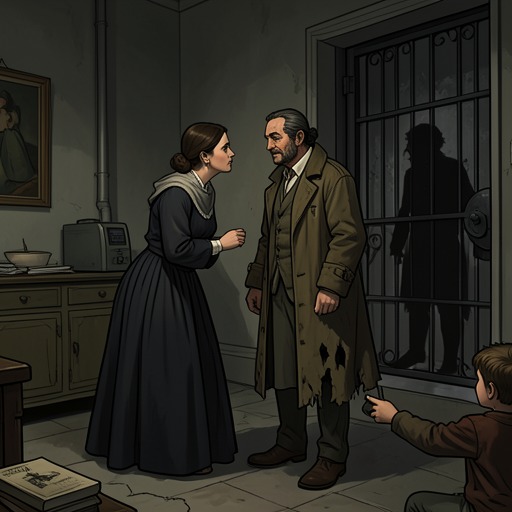
That night, Tancred orders two guards to seize Guiscardo as he emerges from the tunnel and bring him secretly to the palace. He accuses the young man of having shamed him in his own daughter, and Guiscardo offers no denial. Tancred keeps him under guard. The discovery turns a private relationship into a contest over authority: Tancred has the power to imprison and punish, while Ghismonda has not yet been told that her secret has been exposed.
Ghismonda’s Defense
The next day, Tancred speaks to Ghismonda alone. He says that he had believed in her virtue and honesty, objects especially to her choice of a man of low condition, and admits that his love for her conflicts with his anger. He has already decided how to deal with Guiscardo, but claims uncertainty about what to do with his daughter. Ghismonda understands that both her secret and her lover have been discovered. Though grief nearly breaks through in cries and tears, she masters her expression and does not plead for mercy.
Instead, she acknowledges that she loves Guiscardo and says that she will continue to love him for as long as she lives. She explains her choice through both his merit and Tancred’s failure to find her another husband. Her defense rejects the idea that her body and desires can be governed as though she were made of stone: she is her father’s child, made of flesh and blood, still young, and already familiar with the pleasures of marriage. Having experienced desire and found Guiscardo worthy, she says, she acted on her nature while trying to prevent shame from falling on either of them.
Her argument also turns the accusation back on Tancred. She points to the hidden way that allowed their meetings and refuses to treat the affair as something she can undo merely because he has discovered it. If he intends to be cruel to Guiscardo, she warns, he must do the same to her; she will not ask for pardon and will not remain alive if her lover is killed while she is spared. Her composure makes the exchange more than a plea for personal freedom: she claims responsibility for her choice and insists that its consequences cannot justly be imposed on Guiscardo alone.
The Heart and the Ending
Tancred does not believe that Ghismonda will carry out her threat. He orders Guiscardo’s guards to strangle him quietly and bring him his heart. The following morning, he places it in a splendid golden bowl and sends it to his daughter with a message presenting the heart as consolation for the person she loves most. The gift makes Tancred’s retaliation intimate and deliberate: he sends Ghismonda not an account of Guiscardo’s death, but the bodily proof of it.
Ghismonda has anticipated this possibility. After Tancred leaves her, she prepares poisonous herbs and roots, distills them in water, and keeps the vial ready. When the servant arrives, she recognizes Guiscardo’s heart and receives the message without losing her composure. She kisses the heart, acknowledges the worthiness of its golden vessel, and weeps over it. Her women do not understand what the heart or her words mean, but they see her grief and try unsuccessfully to comfort her.
After mourning, Ghismonda says that nothing remains for her to do except join Guiscardo. She pours the prepared poison into the bowl, where the heart has been bathed by her tears, drinks it, and lies down with the dead heart pressed against her own. Tancred arrives as she is dying and weeps, but she tells him to save his tears for another fate. Her final request is that, since he would not allow her to live secretly with Guiscardo, her body may lie openly beside his wherever he has cast him. She dies without withdrawing that demand.
Tancred, overcome by grief and belated repentance, has the lovers honorably buried together in one sepulchre. The ending grants in death the union denied in life, but only after Tancred’s authority has destroyed both people he might have spared. Ghismonda’s story gives particular force to the collection’s attention to women’s constrained circumstances: where her father can act directly and violently, she answers through secrecy, argument, and a final choice over her own body. Her tragedy does not resolve the conflict between rank and personal worth; it makes the human cost of enforcing that hierarchy impossible to overlook.
Narrative Significance
The tale’s reversals are carried by concrete objects and spaces. A hollow cane conceals the letter that opens the lovers’ route; a hidden tunnel makes their meetings possible; a curtain conceals Tancred until chance turns him into a witness. Later, the golden bowl meant to frame Guiscardo’s heart as a cruel gift becomes the vessel in which Ghismonda takes the poison she prepared. These objects successively enable love, expose it, and complete its destruction.
Ghismonda’s insistence that Guiscardo’s worth matters more than his birth also sharpens the contrast between character and inherited position. Tancred’s status gives him control over the household and the punishment, but it does not make his judgment morally sound; Ghismonda, despite her dependent position, argues with clarity and acts with resolve. The shared burial offers a final, somber image of recognition: Tancred grants the lovers in death the closeness he refused them in life, too late to change the outcome.